CleanSweep: The innovative application for cleaning the coasts with the help of artificial intelligence
Data from thousands of cleanups of Greek coasts are now used with the help of artificial intelligence. This predicts where waste is most likely to reaccumulate and how to plan more efficiently for the next…
⏱ 4 min read
Data from thousands of Greek cleanings coastline are now used with the help of artificial intelligence.
This predicts where it is most likely to reaccumulate waste and to plan the next cleaning operations more effectively.
CleanSweep for beach cleanups
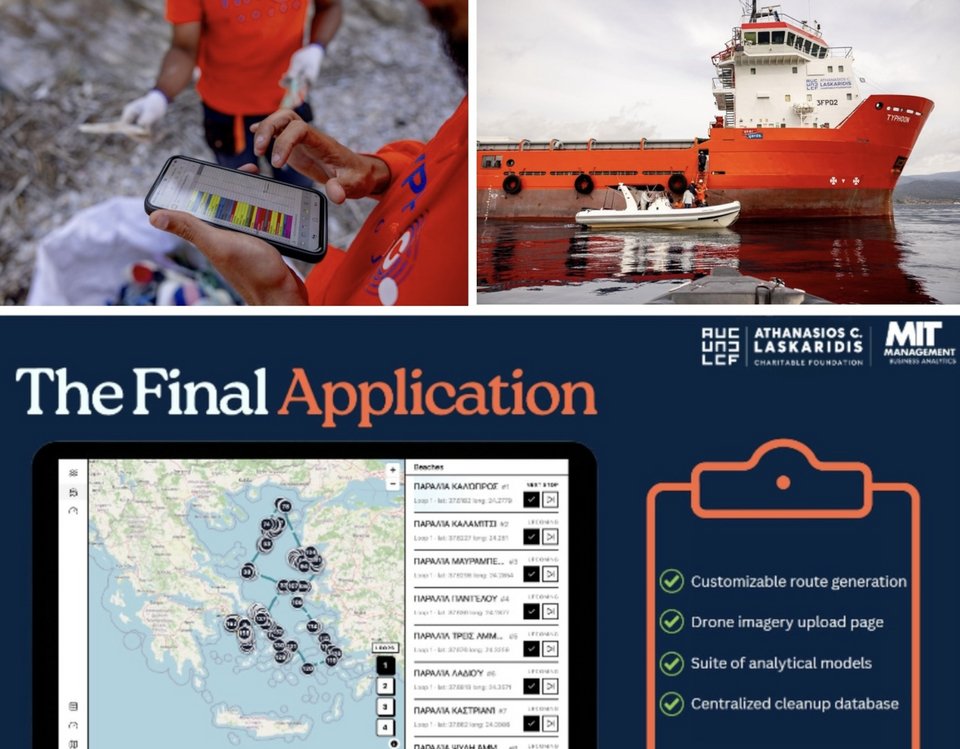
This is the basic logic of CleanSweep, a new digital application that combines re-pollution forecasting models, route optimization, and drone image verification.
ARTICLE CONTINUES AFTER ADVERTISEMENT
More than seven years were used for its development typhoon Project field data and over 3 TB of photos and videos. The platform was developed as part of this year's Capstone Project of the mit Sloan School of Management's Master of Business Analytics program, hosted by the Athanasios K. Laskaridis and based on the data of the Typhoon Project, winning the first place among 44 teams.
In particular, CleanSweep was implemented by students Bria Weisblat and Jocelyn Ju, under the academic guidance of Dr. Dimitris Bertsimas, exploring how the data collected from the Typhoon Project's Coastal Cleanup Operations can be used to design future interventions more effectively.
The Athanasios K. Laskaridis Public Benefit Foundation, as a host organization, provided the research team with access to the Typhoon Project's data and operational experience.
For more than seven years, the Typhoon Project has been cleaning inaccessible and isolated coasts throughout Greece. Each operation is accompanied by systematic recording, through which the program has created one of the largest databases on coastal pollution in the Mediterranean. Having completed a first cleaning cycle, the team now conducts follow-up visits, monitoring how pollution is progressing over time. To date, more than 25,891,000 pieces of waste, corresponding to more than 1,134,000 kg, have been collected and recorded from almost 5,000 beaches.
ARTICLE CONTINUES AFTER ADVERTISEMENT
For the development of CleanSweep, the data collected by the Typhoon Project over the last seven years were used, as well as extensive visual material. Specifically, more than 3 TB of photos and videos from drones were used, along with the operational data set of the program.
The result is a digital tool that uses artificial intelligence and analytical models to predict where littering is most likely to reappear and support more efficient design of cleanup operations. The platform combines re-pollution forecasting models, route optimization, and drone image verification, acting as a decision support tool for coastal pollution management.
The distinction at mit Sloan highlighted the possibilities offered by using real environmental data to develop practical tools with immediate application. At the same time, it brought to the fore the value of systematic collection and documentation of field data, which can form the basis for research, innovation and new approaches to managing environmental challenges.
ARTICLE CONTINUES AFTER ADVERTISEMENT
The "Typhoon Project" began in 2019 with the aim of cleaning up the entire Greek coastline and giving the clean coasts to residents and visitors of the country. The lever of the program is the "Typhoon", a modern, Norwegian-built 72-meter ship, which sails throughout the year decontaminating and transporting the waste collected to recycling or proper disposal structures.
"Typhoon" has five speedboats for cleaning inaccessible coasts and large capacity waste bins, suitable for sorting the items collected in the actions. Its team, consisting of Foundation executives and permanent staff of the vessel, works with academic institutions to support research and better understand the problem of marine pollution in the Mediterranean.
The "Typhoon Project" cooperates with the Laboratory of Marine Geology and Physical Oceanography of the Department of Geology of the University of Patras for the study of benthic waste in the Saronic Gulf and Thermaikos Gulf, as well as with the Marine Remote Sensing Research Group of the University of the Aegean for the identification and mapping of plastics using modern technologies.
CleanSweep gives a new dimension to the Typhoon Project and the many years of action of the Athanasios K. Laskaridis Public Benefit Foundation. More than seven years of cleanups, nearly 26 million. recorded litter, approximately 5,000 beaches and more than 3 TB of visual material are converted from an archive of the problem to a tool to address it. Artificial intelligence and analytical models are now leveraging these data for the prediction of re-pollution, the more effective planning of cleaning routes and the support, through images from drones, of the decisions for the next interventions on the Greek coasts.
ARTICLE CONTINUES AFTER ADVERTISEMENT
ANA-MPA
Reference: galaksias.gr
Machine translation

Comments