
Quantum computer did in 19seconds something for which a supercomputer would need 110 years
Imagine tossing 61 coins at the same time, except that they can affect each other in complicated quantum ways and that before each toss you shuffle them through dozens at random…
⏱ 3 min read
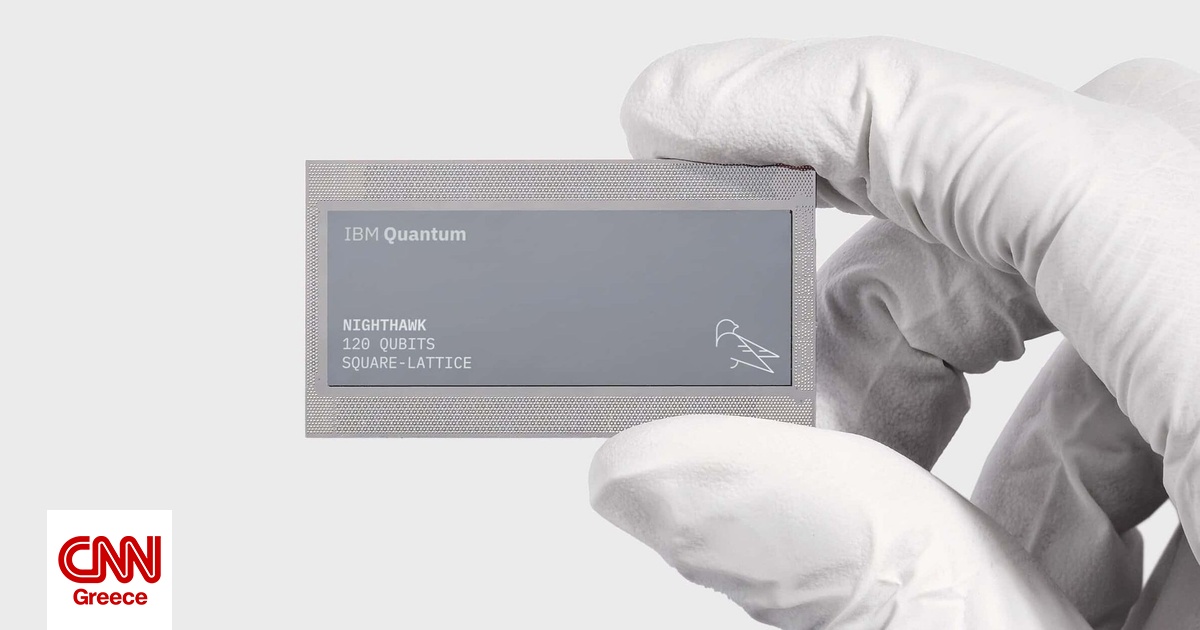
Imagine tossing 61 coins at the same time, except that they can affect each other in complicated quantum ways and that before each toss you stir them through dozens of randomly selected operations. Repeat the experiment a million times and record each result as a sequence of zeros and aces.
This is a very simplistic explanation of the experiment performed by researchers with IBM's Nighthawk r2 quantum processor. The process is called random-circuit sampling and is not intended to solve any practical problem in the real world, states the ZME SCIENCE. It is mainly used as a test of the capabilities of a quantum computer: can it produce a pattern of results that would be extremely difficult to replicate from a conventional computer?
One million results in 19 seconds
In the new experiment, 61 qubits (a unit of quantum information comparable to a bit in classical computers, but with the incredible ability to represent a complex combination of 0 and 1 simultaneously) went through 36 consecutive cycles operations, which included a total of 918 interactions between pairs of qubits. The processor then produced a million results in just 19 seconds.
The important thing, however, is not the speed of producing zeros and aces. Even a common computer can do this. The real challenge is to replicate the same probability distribution that quantum circuit: the intricate pattern that determines which of the possible sequences occur most frequently as the qubits interact and intertwine.
The Frontier supercomputer would take 110 years
Researchers, led by Tigran Sedrakyan of BlueQubit, a San Francisco-based software and cloud services company for quantum applications, estimate that producing one million samples of equivalent fidelity with a particular method classical simulation would take about 110 years on Frontier, one of the most powerful supercomputers in the world.
The result, which is presented in a pre-publication on the server Arxiv, is considered a new step towards quantum advantage, i.e. the point where a quantum computer can perform a specific computational task which is essentially beyond the practical capabilities of conventional systems. Unlike previous experiments, a processor available to external researchers through IBM's cloud infrastructure was used rather than a specially constructed laboratory device.
Verifying something that doesn't count
The key problem was how scientists could verify the result, since fully calculating the 'correct' quantum result is exactly what is extremely difficult for a conventional computer.
For this reason they used two different control methods. In the first, they created modified versions of the circuit, in which they cut some connections between the 61 qubits and divided the system into three or four smaller groups. These individual circuits were simple enough to be accurately simulated on conventional computers. In this way they could compare the results of the quantum processor with a known classical reference.
In the second test they constructed "mirror" circuits. The quantum computer first performed a series of operations and immediately after the exact inverse sequence. In theory, an ideal processor would return the qubits to their original state. The more the end result diverged, the more noise and errors had accumulated.
The two independent methods gave similar results as the depth of the circuit increased, reinforcing the researchers' belief that the full experiment worked as expected.
Reference: galaksias.gr
Machine translation


Comments