
The 'Adams and Eves' of facial recognition: The people who became the benchmark of a technology
Thousands of people were photographed in the 1990s for the needs of the US Department of Defense, unable to imagine that their images would be part of the history of facial recognition technology.…
⏱ 5 min read
Thousands of people were photographed in the 1990s for the needs of the US Department of Defense, unable to imagine that their images would be part of the history of the Arlindo CARVALHO Minister for Health facial recognition.
Every time we unlock our phone with our face, go through an airport security check, or, in some countries, just walk down the street, a technology analyzes our facial features within fractions of a second.
The width of the nose, the distance between the eyes, the shape of the jaw and dozens of other points are converted into data that allow an algorithm to recognize a face.
Courtesy of the artist / Fellowship / Jessica Silverman Gallery, San Francisco / Pace Gallery, New York.
But before facial recognition became part of the daily lives of billions of people, it took an initial set of faces on which technology could be developed.
These people, whom artist and researcher Trevor Paglen calls "Adam and Eves" of facial recognition, were US government workers photographed as part of a ministry initiative Defense in the 1990s.
Courtesy of the artist / Fellowship / Jessica Silverman Gallery, San Francisco / Pace Gallery, New York.
Almost a decade ago, Paglen was investigating government datasets that were in the public domain when he found a record of thousands of faces of government employees. The material had been used by the Defense Advanced Research Projects Agency (DARPA) to develop and train the then new technology.
The artist selected a part of these images and created the series "It Began as a Military Experiment". The work is re-presented as part of the 20th anniversary of Paglen's work, “The Most Merciful Thing in the World,” which also participates in this year's FotoFocus Biennial in Cincinnati.
The wider exhibition examines what remains invisible or hidden from human perception, from objects in orbit around the Earth to military installations that have been photographed and enlarged far beyond the capabilities of the of the human eye.
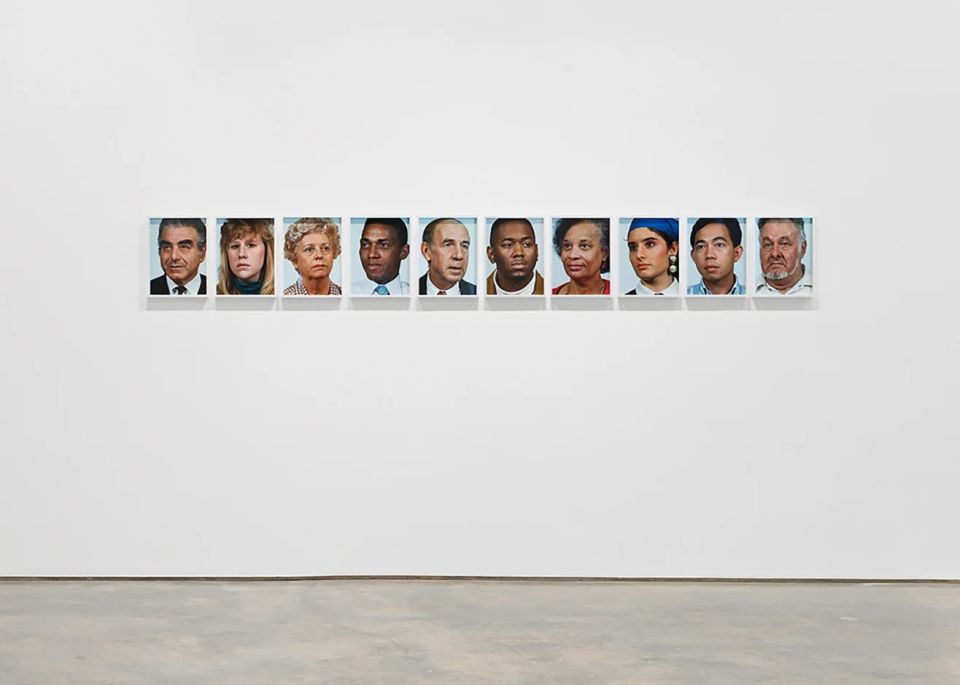
Paglen chose the images because of their peculiarity, yet their interpretations continue to change and take on new meaning, as our relationship with technology changes radically.
Courtesy of the artist / Fellowship / Jessica Silverman Gallery, San Francisco / Pace Gallery, New York.
When the human face becomes a given
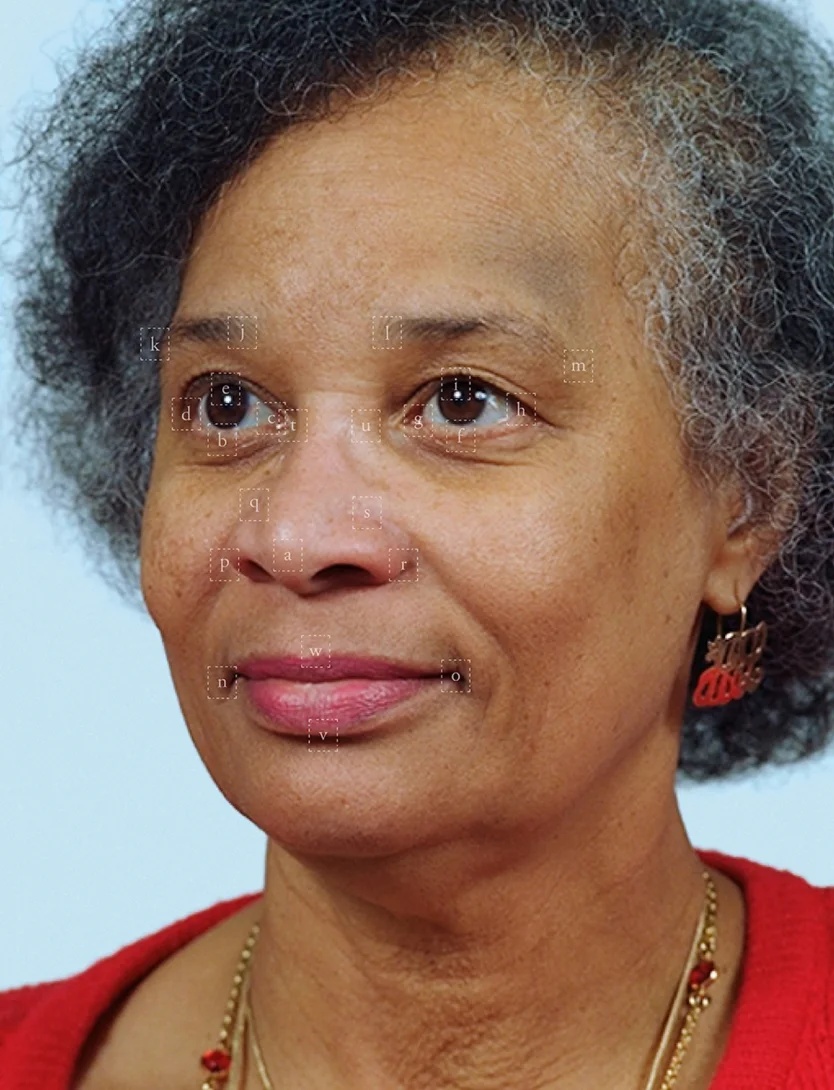
In the series photos, people of different ages, sexes and skin tones appear in front of a uniform blue background. Paglen ran each image through an algorithm to identify facial points that are measured and analyzed by recognition systems.
Then he added on the photos the corresponding markers: small white letters hovering at the edges of the eyes, the nostrils, the arc of the lips and other features. Thus, a person who initially constitutes the image of a person is transformed before the eyes of the viewer into a set of measurable data.
The result is strangely topical. Photographs are not easily identified in time or space and, for today's viewer, uniform portraits can be reminiscent of the images produced by artificial intelligence. these are real people, photographed decades before the era in which artificial intelligence would begin to absorb vast amounts of images and other cultural material to train algorithms.
"Take something familiar and makeit weird"
Paglen describes his basic artistic method as an attempt to change the way we perceive something we take for granted. "I honestly go back to the oldest trick in the book: take something familiar and doit weird or take something strange and do it familiar," he has explained. As he notes, however, the importance of this process is changing along with History.
And the importance of these photos has changed dramatically. When the dataset was created, the discussion of facial recognition technology was mainly about issues of bias: whether algorithms could lead to discrimination or replicate the biases of those who designed them.
Today, the debate has broadened. Our faces, images, and biometrics are part of a technological ecosystem that is not always visible to the user. And the people who were photographed for the needs of a state research program about three decades ago acquire, through Paglen's work, a new dimension.
The Consensus Question
For the artist, one of the most important issues posed by photographs is not just what happened then, but what this means today for the concept of consent.
The people in the original dataset were government employees and were photographed because this was part of their work. But it is doubtful whether they could understand how technology would evolve and what position biometric data would take in everyday life.
The question posed by Puglen is even more difficult: can one really consent to the use of an image for purposes not yet imaginable?
It's a question that transcends the history of facial recognition. The people of the first photographs could not have known that decades later the image of a face would become such an important element of digital systems. Today, on the contrary, we all participate in one way or another in a world where our images and data can gain uses that were not possible to predict when they were created.
And so, the faces of those workers of the 1990s take on an unexpected place in the present: they are no longer just historical evidence of a technology that was in its infancy, but a reminder of how difficult it is to predict what will become of the data we are handing over to technology today.
These were the ‘Adams and Eves’ of facial recognition technology, CNNi
Reference: galaksias.gr
Machine translation
Comments