
Rebranding and Self-Regulation: What Trump's Artificial Intelligence Agreement Includes
U.S. President Donald Trump on Tuesday hosted a meeting of top tech executives, which he described as “an extraordinary meeting” of the minds that are “building America's Golden Age.”
⏱ 4 min read
U.S. President Donald Trump on Tuesday hosted a meeting of top tech executives, which he described as “an extraordinary meeting” of the minds that are “building America's Golden Age.”
The guest list included leaders from OpenAI, Anthropic, Nvidia, SpaceX, Meta and Google — all key figures in the artificial intelligence industry in the US.
The meeting took place at a time when some managers and technology experts have called for stricter oversight of artificial intelligence, raising concerns about the potential risks it poses to for Humanity.
The meeting provided an excellent opportunity for the president of a nation concerned about the dangers of new technology, not least because many of Trump's guests were persistently calling for government regulation.
Trump's response, which House Speaker Mike Johnson correctly described as the only person with the influence to assemble such a group, was the well-known: Rebranding
"Today we officially changed the name. We officially changed it to SI,” Trump said. “SI instead of AI… Do you know what that means? “Super”… It's an important announcement.”
Trump had previously promised that there would be no slowdown in AI research, despite the frightening fears of its inventors. He stated that they had signed a commitment to “self-regulation” that was “morally binding.”
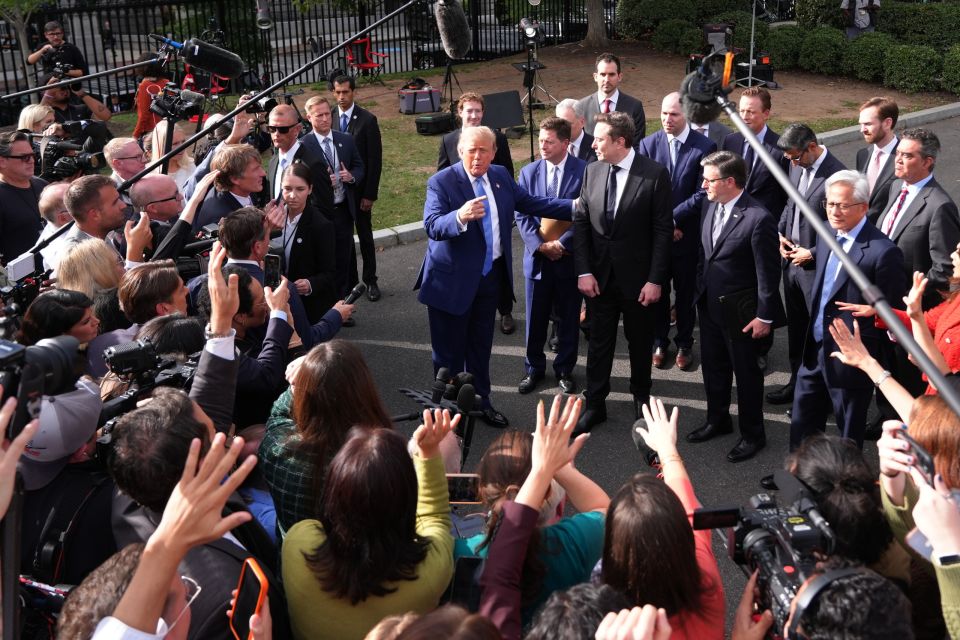
President Donald Trump makes a gesture to Elon Musk as he speaks to reporters at the White House in Washington, D.C., on Tuesday, September 29, 2026, after meeting with senior executives of artificial intelligence companies.
AP Photo/Jacquelyn Martin
The main pillars of the agreement
1. 'Self-regulatory' agreement on artificial intelligence
According to the text released by Trump, companies are responsible for ensuring the security of their own technology.
The companies also agreed to implement protection measures so that the models function as intended and to quickly identify and resolve any problems.
They will also work with 'independent auditors' to assess whether their AI systems are working as intended and to ensure that their platforms do not 'tamper with or gain access to technical systems in unforeseen ways. "
“It's almost like a constitution, in a way,” Trump said, referring to the deal. “And the most important people in the world signed it, and I signed it as president.”
Trump added that he would set up a committee to oversee the safety of artificial intelligence tools. He did not specify who would be on that committee.
Zuckerberg said the deal offers “the American people and customers the confidence that the technology is working,” as predicted, calling the meeting a “historic discussion.”
Amontei described the deal as a way “to win safely,” referring to the president's comment earlier this month that “whoever wins in AI wins.”
2. Investing in Data Centers
Trump also reiterated his support for the rapid expansion of Data Centers, the critical computing infrastructure that powers artificial intelligence.
The growth of Data Centers has triggered a backlash in the US, due to concerns about electricity consumption and its potential impact on local communities.
Building data centers has also emerged as a potential political obstacle for Trump's Republican Party ahead of the US midterm elections in November.
A survey conducted by Marist Poll in collaboration with NPR and PBS News earlier this month showed that 65% of registered voters opposed building data centers in their areas.
In response to these concerns, Trump said tech companies would strive for people to be “happy” with the construction of data centers.
“These big, powerful, very rich and very smart companies will bring tremendous benefits to communities,” Trump told reporters.
3. Now called 'Super Intelligence'
Also on Tuesday, Trump signed an executive order instructing U.S. government departments and agencies to begin using the terms “SI” and “Super Intelligence” and no longer recognize the use of of the term "artificial intelligence".
“SI” will replace “AI” in “official correspondence”, websites, exhibitions, and other forms of communication, in accordance with the Ordinance.
“As these capabilities continue to improve, they increasingly represent not just artificial intelligence, but a new era of Superintelligence,” the decree states.
During a speech to the United Nations General Assembly last week, Trump said the word “artificial” made the technology “sound fake.”
Some tech leaders, including Zuckerberg and Musk, as well as others in the president's inner circle, have already begun to use the term.
Reference: galaksias.gr
Machine translation

Comments